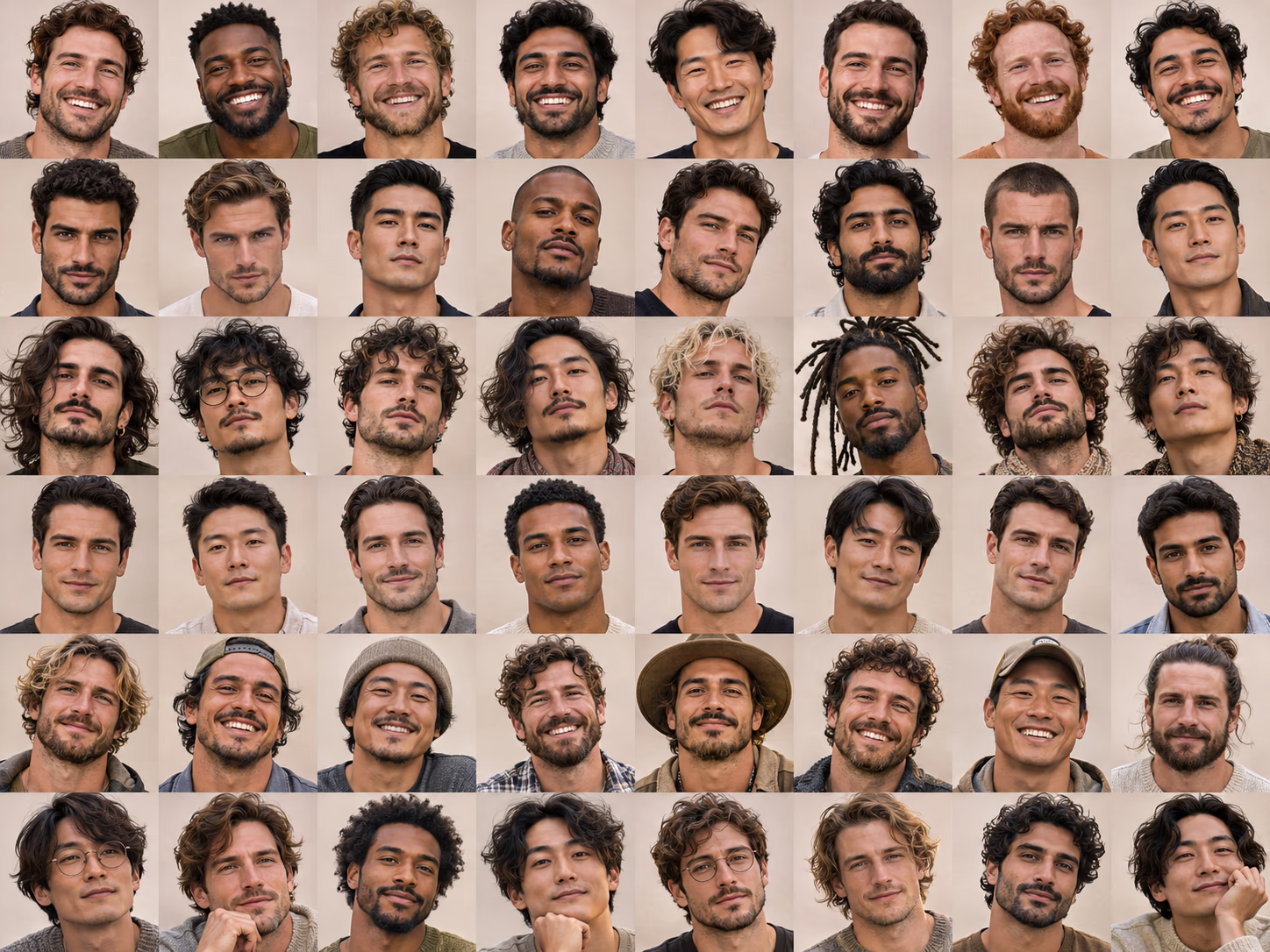
Warm & open
Open smiles · A welcoming look · Soft expressions
THE IDEA BEHIND MyType
A transparent look at how your taps become a result.
Describing your ideal type is hard. Recognizing a face you like is easier. MyType learns from the faces you tap, crowd after crowd, and shows which visible traits keep pulling you in.
MyType starts with a simple observation: describing a face is often harder than recognizing that you like it. We take inspiration from choice-based exploration and implement our own transparent version. We do not use another site’s model, dataset, or portraits.
Each crowd shows 12 portraits and you tap the ones you like. The first crowd samples different styles across the library. After that, every crowd mixes three kinds of faces: ones the model expects you to like, ones it is least sure about, and ones unlike anything else in the crowd. The first 20 crowds use distinct portraits.
The library holds 240 portraits each for men and women (480 for “Everyone”). Your result opens after crowd 20 (20 for “Everyone”) with at least 6 taps in total. Allow about 5–8 minutes; actual time depends on your pace. Once the library is exhausted, later crowds bring back informative faces in new company, never from the previous two crowds. You can continue after viewing your result, up to 60 crowds.
Each portrait carries visible styling labels: hair length, texture and tone, hair pulled back or braided, facial hair, expression, and accessories such as glasses, hats and earrings, plus the six editorial rows the images were generated for. New portraits were labeled through individual visual review by an AI agent and have not had independent human review. Labels never describe skin tone, ancestry, age, health or personality, and we do not build classifiers for those attributes.
New sessions also use image representations prepared offline, helping distinguish portraits that share the same styling labels. The general-purpose DINOv2 encoder runs only when preparing the artwork; the site receives compact fixed numbers. We do not match identities or need your photo. Lighting and styling can still influence these representations, and they have not been validated in a human preference study.
Open smiles · A welcoming look · Soft expressions
Defined features · A composed look · Visual presence
Expressive styling · Textured hair · A distinctive look
Clean styling · Calm expressions · An understated look
Casual styling · Natural texture · An easygoing look
Soft styling · Thoughtful expressions · A quieter presence
A tapped face counts as a yes and the other faces in that crowd count as a no. A small logistic regression estimates how much each trait raises or lowers the odds that you tap, with a gentle penalty so a few lucky taps cannot dominate. Each portrait also keeps a little room of its own, so a face you keep choosing can rise above what its traits predict.
Your type name is the strongest traits, at most one per group. The multiplier beside a trait is your tap rate for faces with it divided by your own average tap rate. “Top 8%” ranks a face against the rest of this library. Selectivity is simply how many of every 12 faces you tap. Every number compares you with this library and with yourself, never with other people.
Before learning each crowd, the model ranks its never-seen faces. We check how often a tapped new face outranks a skipped new face; 50% is a coin flip. Familiar faces measure consistency separately. Results show the comparison sample size and, with enough evidence, an estimated interval from resampling whole crowds. Performance near chance means the model is uncertain, not that your personality or taste is broad.
The free result uses a fixed on-device model and makes no remote AI request for your choices. For a paid report, a numerical summary is sent to OpenRouter’s openai/gpt-6-luna model for a six-part reflection: observed patterns, how the model learned, contrasts, uncertainty, reflection questions, and an open-minded takeaway. Names, emails, and portraits are excluded. AI text never changes your original counts.
An independent exploration of visual taste. No personality diagnosis, compatibility score, or claims about what everyone else likes.
This is a small, curated image library with subjective labels. Mood, lighting, and styling can all affect a choice. It is not a scientifically validated assessment and cannot establish sexuality, mental state, or who you should date.
For further reading about the difficulty of describing visual taste, explore the essays below. They describe mytype.fyi’s own system and do not validate our method. MyType at mytype.lol is an independent product.